TL;DR: An LBO funds a business acquisition primarily with debt. Not the buyer's own cash. In the LMM ($2M–$10M EBITDA), senior lenders typically advance 3.5–4.5x EBITDA, per GF Data Q1 2026 middle-market PE report, with PE equity covering 40–55% of enterprise value. The more EBITDA quality you demonstrate as a seller, the more debt a buyer can access, and the more they can pay.
What a leveraged buyout actually is
An LBO is a business acquisition financed predominantly with borrowed money. The buyer puts in equity, typically 40–55% of the purchase price in an LMM deal. Lenders provide the rest, secured against the company's assets and cash flows.
The logic is straightforward. If a PE firm's equity return target is 20–25% IRR and they're paying 6x EBITDA, they can't hit that number by writing an all-cash check. They use leverage to amplify returns: buy at 6x, exit at 7x, and the return on the equity, not on the full purchase price, drives IRR. Leverage converts an 8% unlevered return into a 20%+ levered one. That is the mechanism.
Every LBO in the lower middle market follows the same architecture. The pieces vary in size depending on deal quality, lender appetite, and buyer type. The structure does not change.
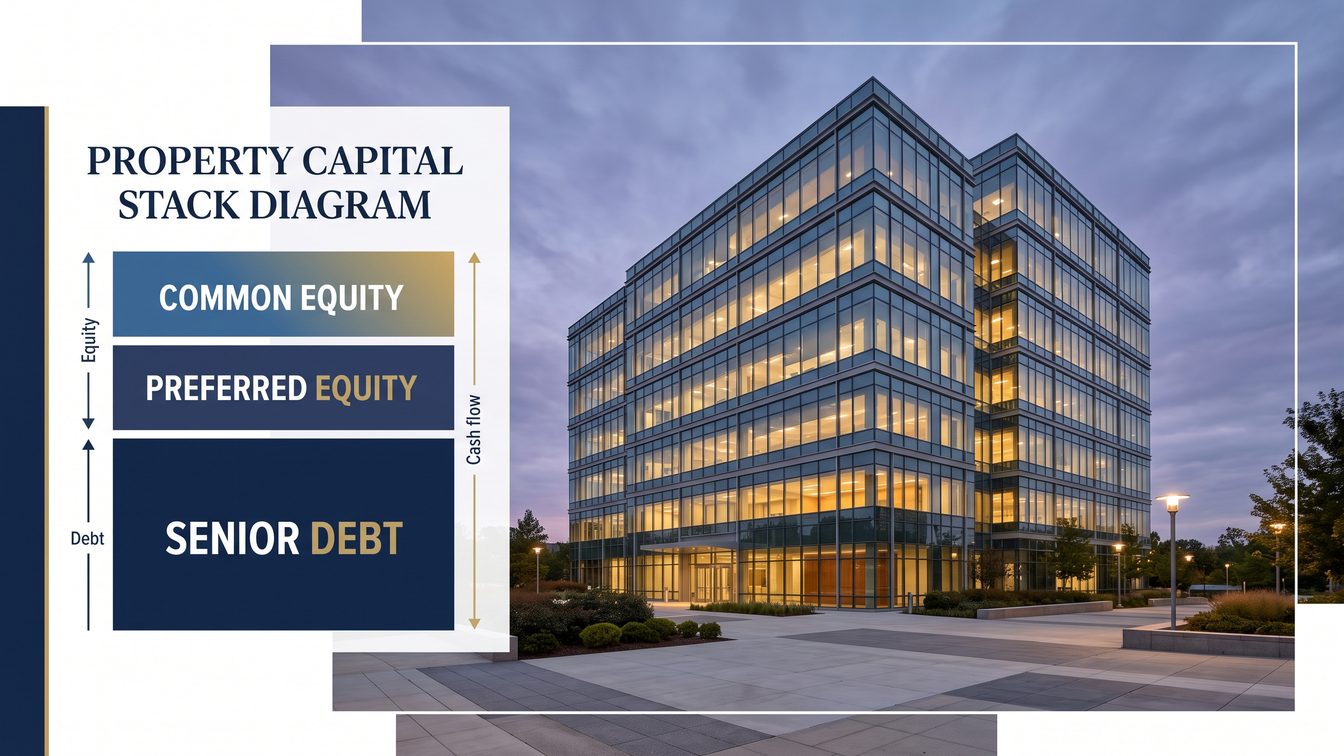
The capital stack: three standard layers
Senior debt is the foundation. In Q1 2026, per GF Data, senior lenders on sub-$25M EBITDA platform deals advanced a median of 3.9x TTM EBITDA. The rate is floating: SOFR plus 400–500 basis points in 2026. The lender takes a first lien on company assets and gets paid before anyone else in any restructuring scenario. Senior lenders typically underwrite to a fixed-charge coverage ratio of 1.2x–1.35x and a total leverage cap of 3.75x–4.25x adjusted EBITDA.
Seller notes appear in most LMM transactions. The selling owner lends a portion of the purchase price back to the buyer. Standard structure: 10–30% of purchase price, 5–7 year term, 6–8% interest, subordinated to bank debt. Seller notes serve two functions. They align seller incentives with post-close performance. They also allow buyers to stretch valuations without increasing bank leverage. Sellers should understand that agreeing to a large seller note means they are financing part of their own sale and absorbing credit risk on that portion.
Equity comes from the PE fund. Fund managers write the check that completes the capital stack after debt is placed. At 40–55% of enterprise value, equity is the most expensive capital in any deal. PE firms target 20–25% IRR on that equity, substantially above the 11–13% they pay for mezzanine debt or 8–9% for senior debt.
Some LMM deals include a mezzanine layer: subordinated debt at 11–13% cash interest plus PIK and warrant coverage. That extends total leverage beyond what senior lenders will provide. Mezzanine is more common in the $50M–$150M enterprise value range. Below $50M, most buyers avoid the intercreditor complexity and premium pricing. When they do use it, providers include specialty lenders like Audax Mezzanine, NewSpring, and BDCs such as Ares Capital and Main Street Capital.
Why EBITDA quality controls deal price
Most sellers miss this. Your valuation isn't a number a buyer picks. It's constrained by what lenders will finance.
Lenders underwrite EBITDA against four criteria: consistency (year-over-year EBITDA stability), predictability (recurring vs. project-based revenue), concentration (what percentage of revenue comes from your top three customers), and management depth (can this business operate without the founder post-close).
A $5M EBITDA business with clean recurring revenue, low customer concentration, and a deep management bench may attract 4x EBITDA of senior debt: a $20M credit facility on a $35M deal. The same $5M EBITDA business with one customer representing 40% of revenue might get 3x from lenders: a $15M facility. The buyer writes a larger equity check or reduces the offer price by $5M.
Customer concentration is the most common financing constraint in LMM deals. Senior lenders routinely haircut EBITDA attributable to any single customer above 20% of revenue. A business with $5M EBITDA where $1.5M comes from one customer may effectively be financed as if it has $3.5M of high-quality EBITDA. That reduces the senior debt advance by $6M–$8M and directly reduces the price a buyer can offer.
EBITDA quality is a financing story before it becomes a valuation story. Fixing customer concentration, documenting management depth, and converting project revenue to recurring revenue are not just operational improvements. They are direct purchase price levers.
The LMM LBO vs. large-market PE
Lower middle market transactions operate with less leverage than large-cap PE. The median total leverage in LMM platform deals runs 3.5–4.5x EBITDA. Large-cap PE in 2021 routinely layered 5.0–6.0x. The difference is structural, not philosophical.
Senior LMM lenders: regional banks, community banks, SBA lenders, specialty shops like Twin Brook Capital and NXT Capital. They apply conservative underwriting standards. The fixed-charge coverage covenant caps how much debt any given business can service. A company generating $5M EBITDA and $3.5M of free cash flow after capex can reliably service a specific annual debt payment. Beyond that ceiling, the deal does not work.
The practical result: LMM operators run leaner post-close than counterparts in large-cap PE. Free cash flow goes to debt service in years one through three. Growth capital competes with mandatory amortization. Operators hired to run PE-backed LMM companies face cash-flow constraints that large-market portfolio companies rarely face.
What happens when leverage is wrong
Deals get into trouble when total leverage exceeds what post-close operations can support. The signal is a total debt-to-EBITDA ratio above 4.5x. At that level, there is minimal margin for error.
Any revenue miss in the first 18 months tightens the fixed-charge coverage ratio. If it breaks the loan covenant, the lender can declare an event of default and demand remediation. Operators who inherit highly-leveraged LMM companies often face their first financial crisis within 24 months. Not because the business is bad, but because the capital structure left no room for normal operating variance.
Before a seller signs a Letter of Intent, they should ask: what is the buyer's total leverage ratio at close? Buyers who can't answer clearly either haven't done the financing analysis or are counting on a seller note to plug a gap they couldn't solve elsewhere.
The mechanics of returns
A PE firm buys a $35M enterprise value business with 4x EBITDA debt ($20M senior loan) and $15M equity. Over five years, two things drive return: EBITDA growth and debt paydown.
If EBITDA grows from $5M to $7.5M and the exit multiple holds at 7x, the exit enterprise value is $52.5M. The debt balance has been reduced from $20M to $14M via amortization. Equity proceeds: $38.5M on a $15M investment: a 2.6x multiple in five years, approximately 21% IRR.
Without debt (a full equity purchase at $35M), the same five-year result produces a $52.5M exit, roughly 8.5% IRR. Leverage converted an 8.5% return into a 21% return on equity. That math is why PE firms use leverage. The same amplification runs in reverse when EBITDA declines. A 10% EBITDA miss in year one wipes out two years of assumed debt paydown and puts the lender covenant at risk before the operator has had time to fix anything.
What sellers should ask before PE diligence starts
Not all LBO structures are equal. Sellers who understand the capital stack can negotiate better terms and select buyers more likely to close.
Ask prospective buyers before signing anything:
- What is your total leverage ratio at close?
- What percentage of the purchase price is seller note versus cash at closing?
- Do you have a debt commitment letter or term sheet from a lender?
- What are the financial covenants on the senior facility?
- Have you completed a quality-of-earnings analysis on this business?
A buyer with a lender commitment letter, total leverage under 4.5x EBITDA, and a seller note below 20% of purchase price is better positioned to close than one who is asking you to carry 30% of your own sale price while still sourcing bank financing.
The leveraged buyout is the mechanism that converts PE equity into returns. Understanding how it works doesn't just make you a more informed seller: it lets you evaluate which buyer is actually going to close, and which one is using your seller note to bridge a financing gap they couldn't solve elsewhere. That's the difference between a clean exit and an 18-month process that falls apart at the closing table.
Frequently Asked Questions
How much of an LBO purchase price is typically covered by debt versus equity?
In lower middle market deals, lenders provide the majority of the purchase price and PE equity covers 40 to 55% of enterprise value. Senior lenders advance a median of 3.9x TTM EBITDA on sub-$25M EBITDA platform deals, per GF Data Q1 2026. The rest of the gap is often filled by a seller note.
What is a seller note and how does it affect the purchase price in an LMM deal?
A seller note is a loan from the selling owner back to the buyer, covering part of the purchase price. Standard structure runs 10 to 30% of purchase price, a 5 to 7 year term, and 6 to 8% interest, subordinated to bank debt. Sellers carrying a large note are financing part of their own sale and absorbing credit risk on that portion.
How does customer concentration affect how much a buyer can pay for a business?
Senior lenders discount EBITDA attributable to any single customer above 20% of revenue, which directly reduces the debt they will advance. A business with 40% of revenue from one customer may be financed as if it has significantly less high-quality EBITDA. That reduction in available debt lowers the price a buyer can offer.
What total leverage ratio signals that a deal is at risk after close?
A total debt-to-EBITDA ratio above 4.5x leaves minimal margin for operating error. Any revenue miss in the first 18 months can tighten the fixed-charge coverage ratio and trigger a lender covenant breach. Operators who inherit businesses at that leverage level often face their first financial crisis within 24 months.