Private equity firms do not fund acquisitions with equity alone. According to the Small Business Investor Alliance's 2024 academic study, junior debt funds (the category that includes mezzanine) outperformed benchmarks by 3.98% IRR across 208 SBIC funds. That number matters because it tells you mezz is not a fringe instrument. It is a standard part of how the lower-middle market finances acquisitions when senior debt runs out and equity costs too much.
Here is what mezzanine financing actually is, what it costs, and why every business owner and operator considering a PE deal needs to understand it before they sign.
Where mezz sits in the capital stack
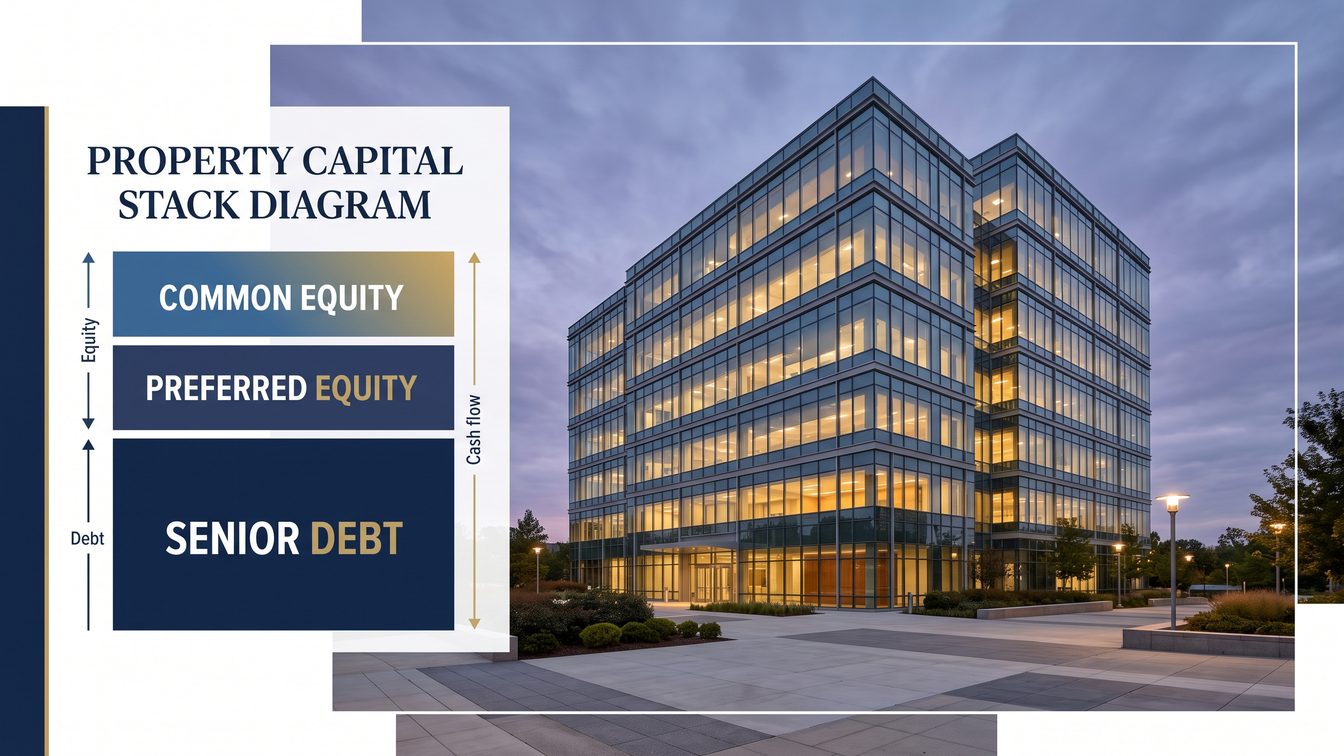
Every leveraged buyout has layers. Senior secured debt goes in first. It has the lowest interest rate, the shortest tenor, and the first claim on assets if the company defaults. Banks and SBA lenders fill this layer.
Equity goes in last. It absorbs losses first, earns returns last, and has no guaranteed payment. The PE sponsor and any co-investors sit here.
Mezzanine financing sits between those two layers. Subordinated to senior debt, senior to equity. If the company goes sideways, senior lenders get paid first. Mezz lenders get paid second. Equity holders get what remains, which may be nothing.
That risk position is why mezz is expensive.
What mezzanine costs in 2026
Mezz lenders price for the risk they take. With 3-month SOFR at roughly 3.7% in mid-2026, mezzanine from business development companies (BDCs) prices at SOFR plus 700 to 900 basis points. That is a floating coupon of 10.7% to 12.7% before any additional features.
Add payment-in-kind (PIK) interest and equity warrants, and the all-in cost reaches 12% to 18% annually depending on credit quality. A weaker company with thinner margins or more leverage pays toward the top of that range. A clean, cash-flowing business with low customer concentration pays toward the bottom.
Compare that to senior secured debt. SBA 7(a) loans for acquisitions currently run around prime plus 2.75% for loans above $50,000, which puts them roughly in the 10% to 11% range. Senior bank debt in the LMM runs 7% to 9% for solid credits. Mezz costs 3 to 6 points more than senior secured for a reason: the lender takes real subordination risk.
Who provides mezzanine in the lower-middle market
The LMM mezz market is fragmented. A handful of categories dominate.
SBIC-licensed mezzanine funds. Small Business Investment Companies backed by SBA leverage are the most active mezz lenders in the LMM. In 2025 alone, five funds closed between $226M and $269M each: Five Points Capital, Centerfield Capital, Southfield Capital, Midwest Mezzanine Funds, and Tecum Capital. Balance Point Capital is another active name. These funds deploy government-guaranteed leverage, which lets them offer competitive pricing on LMM deals the larger private credit market ignores.
Business development companies. Publicly traded BDCs like Main Street Capital and Kayne Anderson BDC regularly report mezz and subordinated debt positions in their FY filings. Main Street alone manages over $5 billion in assets across debt and equity investments in LMM companies. Their Q1 2025 earnings show the volume of LMM credit they absorb.
Family offices and direct lenders. Some family offices run internal credit programs that provide mezz to deals in their geographic region or industry focus. These are relationship-driven and rarely appear on public databases.
NewSpring Capital's mezzanine strategy is a named example of a dedicated LMM mezz fund targeting companies with $3M to $20M EBITDA, which brackets most deals in Patriot Growth Capital's acquisition range.
Mezz vs. unitranche vs. SBA: choosing the right instrument
Ten years ago, most LMM buyouts used a two-layer structure: senior debt plus mezz. That changed fast. Private credit now handles roughly 90% of middle-market LBO lending, up from 36% in 2014. A large part of that shift is unitranche debt.
Unitranche collapses the senior and mezzanine layers into a single loan with a single interest rate. The lender syndication happens behind the scenes among the credit fund's investors, not in the deal's capital table. For a buyer, unitranche means one lender relationship, one covenant set, and a blended rate that typically lands between what senior and mezz would cost separately. For deals in the $5M to $30M enterprise value range, unitranche from a direct lender or BDC is often cleaner than stacking two instruments.
SBA 7(a) is different again. An SBA loan covers acquisition financing up to $5 million (with standard programs) and offers longer amortization periods than conventional senior debt. For buyers without significant equity capital, SBA financing can replace mezz entirely if the deal size fits. The tradeoff is more paperwork, a required seller note in some structures, and real estate or personal guarantee requirements.
The instrument choice affects more than interest rate. It affects the seller's experience, closing timeline, and the buyer's covenant exposure post-close.
The equity kicker: what sellers need to see clearly
Mezzanine lenders rarely take just a cash coupon. Most mezz packages include an equity kicker, either warrants on the company's stock or the right to participate in equity upside on exit.
For a business owner selling a minority stake or taking on a growth partner, this matters. A mezz lender who holds warrants has a financial interest in the company's equity outcome, not just its ability to service debt. That creates a different alignment than a senior secured lender who only cares about coverage ratios.
When a PE firm structures a deal with mezz financing, the seller should ask two questions. First: what is the total capital stack and where does the equity sit? Second: who holds the warrants and how do those warrants get exercised or cancelled?
A PE firm that structures $10M of senior debt, $3M of mezz with 3% warrant coverage, and $5M of equity is effectively paying for the company with a mix of instruments that carry different claims on the business. The business owner who understands that capital stack can negotiate more effectively than one who sees only the headline purchase price.
The risk that does not show up in the term sheet
Mezz debt carries one risk that rarely gets a clean explanation: covenant sensitivity.
Senior lenders set financial covenants. Mezz lenders set their own, typically less restrictive at origination. But in a downturn, both sets of covenants can trigger at the same time. The business then has two creditor relationships in default, not one. Workout negotiations with multiple creditor layers are slower, more expensive, and more likely to result in equity dilution or loss.
For operators running businesses where EBITDA is seasonal or lumpy, the mezz structure adds risk that a straight equity deal does not. That is not an argument against mezz. It is an argument for understanding what you are accepting when a deal includes it.
Where Patriot Growth Capital lands on this
At PGC, our acquisition model starts with the business, not the capital stack. We look for companies with $2M to $10M EBITDA, defensible market position, and an owner who wants to transition on their terms. The capital structure we bring to a deal depends on what the business supports, not what a lender will approve.
That sometimes means mezz. It sometimes means SBA financing. It sometimes means equity-heavy structures with less debt. The right answer is the one that lets the business grow without the debt service becoming a ceiling on operations.
Veteran-founded and veteran-led businesses sometimes have access to SBIC-backed mezz through channels that civilian businesses do not. If your business qualifies and the deal structure calls for it, that can be a genuine advantage.
What to take from this
Mezzanine financing is not exotic. It is a standard tool in LMM buyouts. It costs 12% to 18% all-in, it sits below senior debt in the capital stack, and it usually comes with equity participation for the lender.
If a PE firm proposes a deal that includes mezz, the right question is not whether mezz is good or bad. The right question is whether the business can comfortably service the full capital stack at the proposed deal price, and whether the warrant structure aligns the mezz lender's interests with yours.
Run the debt service coverage numbers before you run anything else. A business doing $2M EBITDA with $8M of total debt has a 4.0x leverage ratio. Add mezz at 15% interest on a $2M tranche and the annual interest bill on that tranche alone is $300,000. That is real cash out of the business every year before any equity return.
Know what you are agreeing to. The capital stack is where deals succeed or fail after close, not at the signing table.
If you are evaluating a PE offer and want a second read on the capital structure, our guide on selling to private equity covers the deal process from a business owner's perspective.
Frequently Asked Questions
Where does mezzanine debt sit relative to senior debt and equity in a buyout?
Mezzanine is subordinated to senior debt and senior to equity. If a company defaults, senior lenders get paid first, mezz lenders second, and equity holders receive what remains. That risk position is why mezz carries a higher cost than senior secured debt.
What does mezzanine financing cost in 2026?
With 3-month SOFR at roughly 3.7% in mid-2026, mezzanine from business development companies prices at SOFR plus 700 to 900 basis points, a floating coupon of 10.7% to 12.7%. Add payment-in-kind interest and equity warrants and the all-in cost reaches 12% to 18% annually depending on credit quality.
What is an equity kicker, and why does it matter to a business owner?
An equity kicker is warrants on company stock or the right to participate in equity upside on exit, included in most mezz packages on top of the cash coupon. A mezz lender holding warrants has a financial interest in the company's equity outcome, which creates different alignment than a senior lender who only cares about debt coverage.
How does a unitranche loan differ from a traditional senior-plus-mezz structure?
Unitranche collapses the senior and mezzanine layers into a single loan with one interest rate and one lender relationship. The lender syndication happens behind the scenes. For deals in the $5 million to $30 million enterprise value range, unitranche from a direct lender or BDC is often cleaner than stacking two separate instruments.