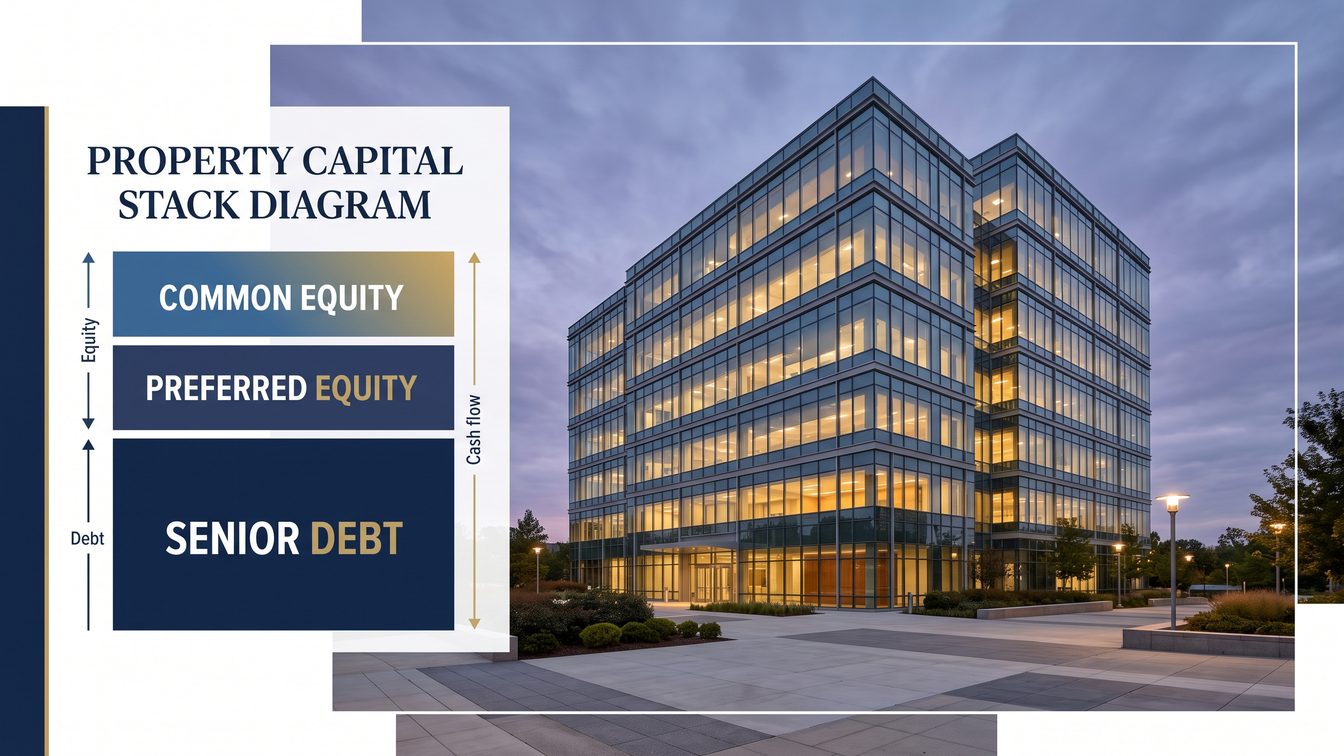
Preferred equity in real estate is not complicated. It is a capital stack layer that sits above senior debt and below common equity. Sponsors use it when the senior loan does not cover enough of the acquisition cost and they do not want to give up full equity participation. Investors use it when they want a predictable return with some downside protection. JPMorgan's commercial lending team describes preferred equity as one of four standard layers in the capital stack, with payment priority sitting ahead of common equity holders but behind all debt obligations. This article breaks down what preferred equity actually costs, how it differs from mezzanine debt, and when it makes sense to use it in a deal.
The capital stack in plain terms
Every commercial real estate transaction is funded through a stack of capital. Each layer carries a different risk level and earns a different return. From bottom to top:
- Senior debt: First mortgage, secured by the property. First in line for repayment. Lowest cost, typically base rate plus a spread. Loan-to-value generally 50% to 75%.
- Mezzanine debt: A loan secured by a pledge of ownership interests in the property entity, not by the property itself. Costs more than senior debt. UCC foreclosure rights on default.
- Preferred equity: An equity investment in the property entity with a contractual preferred return. Paid before common equity. No mortgage lien, no UCC rights. Contractual remedies only.
- Common equity: Sponsor and investor ownership. Last paid. First to absorb losses. Full upside exposure.
Not every deal uses all four layers. A straightforward acquisition might need only senior debt and common equity. When there is a gap in the capital structure, sponsors bring in subordinate capital to fill it. Preferred equity is one option for closing that gap.
What preferred equity actually is
Preferred equity is an ownership stake, not a loan. The investor acquires an interest in the entity that owns or controls the property. In exchange, the investor receives a priority return before any distributions flow to common equity. That priority return is the preferred return, often expressed as a percentage of invested capital per year.
Preferred equity typically occupies 10% to 25% of the total capital structure, according to research from Neutral's capital markets team. In a $50 million acquisition where senior debt covers $30 million (60%) and the sponsor needs $20 million more, a preferred equity investor might contribute $10 million at a negotiated preferred return, with the sponsor's common equity covering the remaining $10 million.
The critical distinction: preferred equity is an equity position with negotiated rights, not a statutory claim. If the sponsor fails to pay the preferred return, the investor's remedies come from the operating agreement, not from foreclosure law. Those remedies might include the right to take over management, replace the general partner, or force a sale. They vary by deal and depend entirely on what was negotiated upfront.
Hard versus soft preferred equity
Preferred equity comes in two forms, and the difference matters to both sponsors and investors.
Hard preferred equity functions like debt. It carries mandatory redemption dates, fixed payment schedules, and aggressive remedies. If the preferred return is not paid, the investor can enforce rights that include removing the sponsor and taking operational control. It is the stricter form. Investors who want certainty prefer it. Sponsors who value control avoid it when possible.
Soft preferred equity behaves more like true equity. If the property cannot pay the preferred return, unpaid amounts accrue and roll forward rather than triggering an immediate default or change of control. The investor gets paid eventually, on exit or refinance. It is more flexible for the sponsor and more patient capital for the investor. The trade-off is that the investor has less leverage if things go sideways.
Which form gets used depends on the deal, the property type, the hold period, and the negotiating power of each party.
What preferred equity costs
Preferred equity investors typically target returns in the 10% to 15% range, according to capital markets data from GS Partners. That range reflects the risk position: more expensive than senior debt, less expensive than common equity's target IRR.
Some preferred equity structures include a fixed preferred return only. Others add participation rights, giving the investor a share of appreciation above a certain threshold. A participating preferred equity investor might earn a 10% preferred return plus 20% of profits above a 15% IRR to the common equity. The exact terms depend on how much leverage the sponsor has and how competitive the capital environment is.
From a sponsor's perspective, preferred equity capital is expensive. Every dollar of preferred equity reduces the return to common equity. The math only works if the property generates enough cash flow and appreciation to cover the preferred return and still leave acceptable returns for the sponsor and common equity investors.
Preferred equity versus mezzanine debt
Preferred equity and mezzanine debt occupy similar positions in the capital stack. They fill the same gap, they target similar returns, and they both give subordinate capital providers certain rights when things go wrong. The differences are structural and legal.
Mezzanine debt is a loan. The mezzanine lender has UCC Article 9 foreclosure rights on the ownership interests in the property entity. If the borrower defaults, the mezzanine lender can foreclose and take control of the entity through a process that is faster than a traditional real estate foreclosure. Senior lenders require an intercreditor agreement before permitting mezzanine debt, and many senior lenders restrict or prohibit it entirely.
Preferred equity is not a loan. There is no UCC foreclosure. Remedies are contractual, negotiated in the operating agreement. Because preferred equity does not create an additional secured creditor with foreclosure rights, some senior lenders allow it where they would prohibit mezzanine debt. This makes preferred equity useful when the senior lender's loan documents restrict subordinate debt structures.
For investors, mezzanine debt is generally considered less risky because the enforcement mechanism is clearer and faster. For sponsors, preferred equity may offer more flexibility on payment timing, particularly in a soft structure. The better choice depends on what the senior lender permits, the deal's risk profile, and the cost difference between the two options for that specific transaction.
If you are building an understanding of how private equity structures acquisitions and capital, see our breakdown of private equity waterfalls and distribution structures for context on how preferred returns interact with promote calculations.
When operators use preferred equity
Preferred equity shows up in commercial real estate deals for a few distinct reasons.
Filling a capital gap. When the senior loan and available common equity do not cover the full acquisition or development cost, preferred equity fills the shortfall. The sponsor gets the deal done without diluting common equity participation further than necessary.
Senior lender restrictions. Many senior lenders prohibit mezzanine debt outright or require complex intercreditor agreements. If the senior lender will not allow mezzanine, preferred equity is often the only subordinate capital option available.
Recapitalization events. Owners who want to pull equity out of a property without selling can bring in a preferred equity investor to recapitalize. The investor receives a preferred return and an ownership stake; the sponsor returns capital to limited partners or recycles it into other deals.
Bridge financing. In transitional deals, where a property is being repositioned or a permanent loan is not yet available, preferred equity can provide short-term capital while the sponsor executes the business plan.
What preferred equity investors evaluate
Preferred equity investors underwrite differently than senior lenders. Senior lenders focus heavily on debt service coverage and loan-to-value. Preferred equity investors care about those metrics too, but they also evaluate the sponsor's execution track record, the operating agreement's remedy provisions, and the exit scenario's ability to repay the entire preferred equity stack before common equity participates.
The key question for a preferred equity investor: if the property performs below plan, can the equity still be returned ahead of a loss to the preferred position? That requires modeling a range of exit scenarios, not just the base case. A deal that looks fine at the base case but wipes out preferred equity in a moderate downside scenario is not attractive capital to deploy regardless of the return profile in a good scenario.
Preferred equity investors also evaluate the sponsor's alignment. A sponsor who has meaningful common equity at risk is a better counterparty than one who structured the deal so that a modest shortfall eliminates their skin in the game before the preferred equity takes any loss.
Frequently Asked Questions
What is preferred equity in real estate and how does it differ from common equity?
Preferred equity is an ownership stake in a property entity that carries a priority return ahead of common equity. Common equity holders receive distributions only after preferred equity investors receive their agreed return. Preferred equity does not have a mortgage lien on the property and its remedies in a default come from the operating agreement, not from foreclosure law.
What returns do preferred equity investors typically target in commercial real estate?
Preferred equity investors in commercial real estate typically target returns in the 10% to 15% range per year. Some structures include participation rights that give the investor a share of appreciation above a specified threshold, potentially increasing total returns if the property performs well.
When should a sponsor choose preferred equity over mezzanine debt?
A sponsor should consider preferred equity when the senior lender prohibits mezzanine debt or will not accept the additional complexity of an intercreditor agreement. Preferred equity may also make sense when the sponsor wants more flexible payment terms than a mezzanine loan requires, or when a soft preferred structure allows unpaid returns to accrue without triggering an immediate default.
What happens if a sponsor does not pay the preferred return?
In a hard preferred equity structure, failure to pay the preferred return can give the investor the right to remove the general partner, take over management, or force a sale, depending on the operating agreement. In a soft preferred equity structure, unpaid amounts typically accrue and are paid at exit or refinance without triggering those remedies. The specific outcome depends entirely on what was negotiated in the operating agreement before the capital was placed.