The 2024 Stanford Search Fund Study tracked 597 search funds since 1984. Median investor returns: 35% IRR and 5.5x MOIC. That's not a typo. Most operators, however, couldn't explain why those numbers are achievable. They understand the deal. They don't understand the model that delivers the check. According to Yale SOM research published in 2025, search fund entrepreneurs frequently accept equity terms without fully understanding what they've signed.
This is fixable. Here's how the economics actually work.
Two phases of money
A traditional search fund operates in two distinct capital phases. Get this wrong and every subsequent number gets distorted.
Search capital funds the search. Typically $400K to $600K, raised from 10 to 15 investors in $25,000 or $50,000 units. This money pays your salary, travel, deal fees, and operating costs for the 18 to 24 months you spend sourcing companies. If you never close a deal, this money is gone. Investors know that. One in three funded searches ends without an acquisition, which is exactly why search capital carries special conversion terms when a deal does close.
Acquisition capital funds the purchase. This is the equity portion of the deal, typically $2M to $10M or more. Search capital investors have the right, not the obligation, to convert their units into acquisition equity. Most do. New investors can join at this stage at standard acquisition-stage pricing.
The step-up: compensating for binary risk
Here's the mechanism that makes search-stage investing attractive despite a 33% deal failure rate: the step-up.
Every dollar of search capital invested converts to $1.50 worth of acquisition equity at closing. A $50,000 search-stage commitment becomes $75,000 in acquisition equity at close. Standard multiple: 1.5x. Some structures run to 2.5x depending on search complexity, deal size, and investor negotiation.
The math is deliberate. Investors are being paid for the risk of funding you when there's no deal. No company, no cash flow, no collateral. Just your judgment and your execution. One-third of searches prove them wrong. The step-up is the premium on the two-thirds that work.
Investors exercise their step-up rights and also invest additional acquisition equity at the standard acquisition-stage price per unit. Their effective cost basis per unit ends up lower than new investors who only come in at acquisition stage, a meaningful advantage that compounds through the waterfall.
The acquisition capital stack
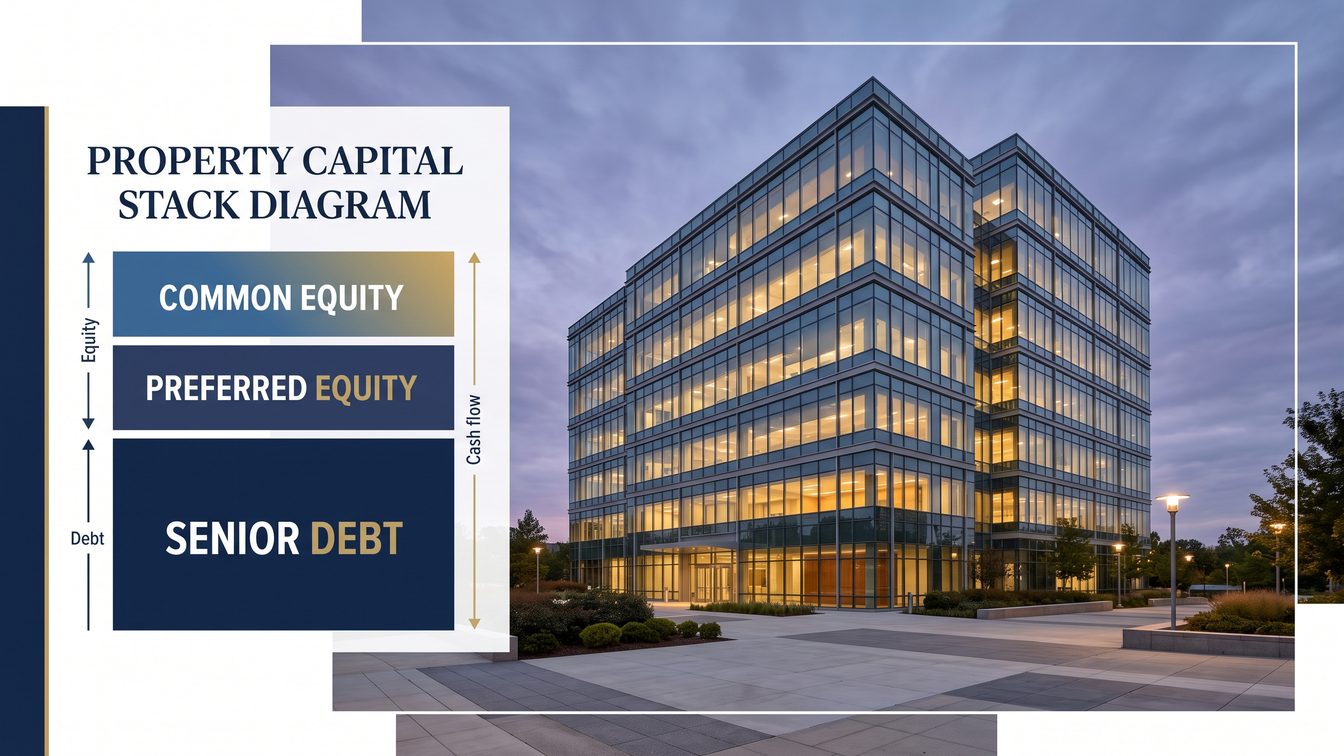
The total deal price doesn't come from investors alone. A typical acquisition financing structure looks like this:
- Senior debt: 30 to 40 percent of enterprise value. SBA 7(a) loans are common for sub-$5M deals; conventional bank debt for larger acquisitions. Lowest cost of capital. Strictest covenants. Your debt service coverage ratio becomes an operating constraint for the first several years post-close.
- Investor equity: 50 to 60 percent of enterprise value. The most expensive capital on the cap table. Investors hold preferred equity, which means they get paid before you do on any distribution or exit.
- Seller notes: 10 to 20 percent of enterprise value. Subordinated debt. The seller takes back a note, directly aligning their post-close incentives with yours. They don't get paid in full until the business performs.
That stack is leveraged by design. You're buying a cash-flowing business and using its cash flow to service debt. The operator's job is to protect and grow that cash flow. When you do, equity value above the debt and preferences flows to investors first, and then to you.
What you actually own
Search fund operators typically earn 20 to 30 percent of fully diluted equity. That's the manager equity pool, sometimes called the carry or the founder's stake. It does not come all at once. It vests in three tranches, each representing roughly one-third of your total allocation:
- Close equity: vests immediately at acquisition. You found the deal, you signed the LOI, you closed. One-third is yours on day one of ownership.
- Time equity: vests ratably over four to five years. You stay, you lead, you execute. This is the operating commitment tranche. Most structures include a 12 to 24 month cliff before any time equity vests.
- Performance equity: vests only if you hit investor return targets. IRR hurdles typically start at 20 percent and scale to 35 percent. At 20 percent IRR, the performance tranche pays nothing. At 35 percent IRR, the full tranche vests. At 28 percent IRR, you earn roughly 53 percent of the eligible performance shares.
The IRR used for performance vesting is the net IRR delivered to investors, after your equity allocation is factored in. Not gross. This means your carry is self-limiting in a specific way: taking more equity lowers the IRR benchmark you're being judged against. Align your interests with your investors' interests. The structure demands it.
The preferred return hurdle
Before you see a dollar of carry, investors collect their preferred return. Standard rate: 8 to 10 percent per annum, cumulative, compounding from the date each investment was made. This applies to their total capital contribution, the step-up value plus any co-investment at acquisition stage.
Run the numbers on a five-year hold. If investors put in $5M at acquisition and the preferred return is 8 percent, they've accrued roughly $2.3M in preferred return over five years before distributions begin. Add that to their $5M of returned capital. That's $7.3M out before your carry participates in one dollar of upside.
This is not punitive. It's the cost of access. These investors funded your search when you had no deal, no operating history, and no collateral. The preferred return compensates them for that capital sitting at risk during the early hold period when operating cash flows are most uncertain.
The exit waterfall
When the business sells, proceeds flow in strict priority order:
- Senior debt repaid in full
- Investor preferred return plus return of invested capital
- Remaining proceeds split between investors and the operator's carry: typically 70 to 80 percent to investors, 20 to 30 percent to the operator on the residual
The last step is where the operator's real return lives. For a business acquired at $4M EBITDA and sold at a 6x multiple five years later, that's $24M in enterprise value at exit. After debt repayment and the preferred return hurdle, meaningful residual remains. If the carry is 25 percent of residual, the operator's economics are substantial. If the exit multiple compresses or EBITDA stays flat, the waterfall may consume most of the exit proceeds before carry kicks in.
Operators who grow EBITDA two to three times and expand exit multiples generate returns that are disproportionately large relative to their equity stake. Operators who hold flat businesses for five years discover that a 10 percent preferred return, compounded annually, requires more growth than they anticipated.
Why the Stanford data holds up over 40 years
Search funds have outperformed buyout PE on median IRR for four decades. Not every deal. Individual variance is wide. But the portfolio average is durable, and the structure explains it.
The step-up concentrates upside for early investors and attracts quality capital to the search stage. The preferred return forces operators to drive genuine cash-flow growth rather than financial engineering. The three-tranche vesting aligns the operator's incentives over a four to five year window, not a 90-day sprint. And the leverage on an owner-operated, cash-flowing small business produces a different return profile than the mega-buyouts that dominate PE headline numbers.
The model works because every mechanism reinforces the same behavior: build a real business, operate it well, protect the balance sheet.
What operators get wrong before they sign
Two mistakes appear in search fund negotiations repeatedly.
First, operators underestimate the compounding effect of the preferred return. Eight percent on $5M over five years is $2.3M of hurdle before carry moves. Build a waterfall model before you accept investor terms. Know exactly what exit price clears the preferred at various hold periods and EBITDA scenarios.
Second, operators anchor on the carry percentage without stress-testing the exit multiple. A 25 percent carry stake in a business sold at a compressed multiple delivers less than a 20 percent stake in a business sold at an expanded multiple. The numerator matters more than the percentage. Build EBITDA. Operators who understand what investors expect at exit align their operating priorities accordingly from day one.
The economics reward operators who treat the business like their primary job, not their funding vehicle. That's the pattern in the Stanford data. Searchers who close good deals at fair prices, operate with discipline for five or more years, and build real strategic value capture most of the upside the structure was designed to deliver.
Model it before you sign it
Search fund economics are layered, not complicated. Search capital funds the search. The step-up compensates early-stage risk. The acquisition stack levers the return. The three-tranche equity structure aligns the operator over the hold period. The preferred return ensures investors get paid before carry activates. The exit waterfall determines what flows to you when you sell.
Every operator who signs a search fund term sheet should be able to draw this on a whiteboard before the ink dries. If you can't model the waterfall, you can't optimize for it. Know the structure. Operate toward the exit. The model rewards the operators who do both.
Frequently Asked Questions
What does the step-up mechanism do in a search fund capital structure?
Every dollar of search capital invested converts to $1.50 worth of acquisition equity at closing, the standard 1.5x step-up. Some structures run to 2.5x depending on search complexity and deal size. The step-up compensates investors for the risk of funding a search with no deal, no cash flow, and no collateral, given that one in three funded searches ends without an acquisition.
How does the preferred return affect what operators collect at exit?
Before you see a dollar of carry, investors collect their preferred return, typically 8 to 10 percent per annum, cumulative, compounding from the date each investment was made. On a five-year hold with $5 million in investor capital at 8 percent, the preferred return alone accrues roughly $2.3 million before distributions begin, on top of returning the original $5 million.
How does the operator's carry vest across the operating period?
Carry vests in three tranches of roughly one-third each. The first tranche vests immediately at acquisition close. The second vests ratably over four to five years of operating as CEO, typically with a 12 to 24 month cliff. The third vests only if investors hit IRR hurdles, usually starting at 20 percent and scaling to 35 percent.
What are the two most common mistakes operators make before signing search fund terms?
First, operators underestimate the compounding effect of the preferred return. A waterfall model built before accepting terms shows exactly what exit price clears the preferred at various hold periods. Second, operators anchor on the carry percentage without stress-testing the exit multiple, because a 20 percent stake in a business sold at an expanded multiple delivers more than a 25 percent stake in a business sold at a compressed multiple.