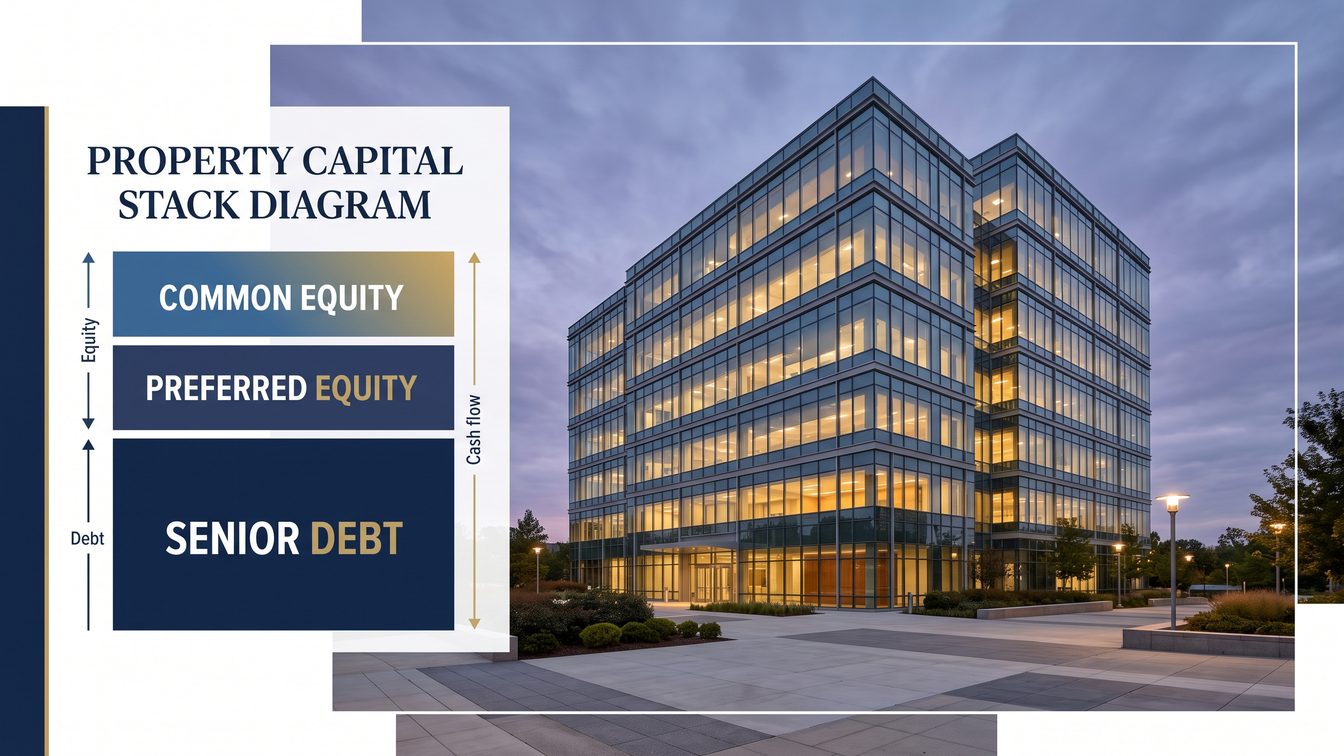
According to the Stanford 2024 Search Fund Study, the median search fund acquisition closed at $14.4 million. Most first-time buyers don't have $14 million in their bank account. That gap between what you're buying and what you can write a check for is where the capital stack lives.
Understanding search fund acquisition financing isn't optional. It's the difference between a deal that closes and a deal that dies at the lender stage. The mechanics are learnable. The mistakes are expensive. Here's how the numbers actually work.
The Capital Stack, Explained
A capital stack is the hierarchy of claims on the business you're buying. Senior debt sits at the top. It gets paid first if the business struggles. Equity sits at the bottom. It absorbs losses first but captures all the upside. Everything in between (seller notes, mezzanine debt, junior tranches) lives somewhere on that spectrum.
For a typical search fund acquisition in the $3-10 million enterprise value range, the capital stack looks roughly like this:
Senior debt: 50-65% of purchase price. This is your SBA 7(a) loan or conventional bank financing. It's the cheapest capital in the deal because the lender has the first claim on assets.
Seller note: 10-20% of purchase price. The seller defers a portion of the purchase price, receiving payments over time from the business's cash flows. This reduces your upfront cash requirement and signals the seller's confidence in the business they're selling.
Equity: 20-35% of purchase price. In a traditional search fund, this comes from the investors who funded your search. In a self-funded search, this comes out of your own pocket, often as low as 10% when SBA financing is structured correctly.
SBA 7(a): The Engine of Most ETA Deals
The SBA 7(a) program is the reason self-funded search works. Without it, buying a $2 million business would require $1-1.5 million in equity. That number eliminates most buyers. With it, the math changes entirely.
SBA 7(a) parameters for business acquisitions:
Maximum loan: $5 million per borrower. This puts the SBA squarely in the lower-middle-market where most search funds operate.
Maximum financing: Up to 90% of total project cost, which includes the purchase price, working capital, and eligible closing costs.
Term: 10 years, fully amortizing. Real estate portions can extend to 25 years.
Interest rate: Variable, typically Prime plus 2.25-2.75%. As of mid-2026, that puts most SBA acquisition loans in the 9-11% range. The rate adjusts quarterly.
Equity injection: The SBA requires a minimum 10% equity injection from the buyer. Lenders may require more based on deal risk. The injection must come from documented sources: personal savings, asset sales, or a properly structured seller standby note. Borrowed funds don't count.
Personal guarantee: Required from any owner holding 20% or more. The SBA is not making a non-recourse bet. You are on the hook personally.
The 80/10/10 Structure
Self-funded searchers use SBA 7(a) financing in a structure that's become almost standard: 80% SBA loan, 10% seller note on standby, 10% buyer equity. This is the 80/10/10.
On a $2 million deal, it looks like this:
SBA 7(a) loan: $1,600,000 at Prime + 2.75%, 10-year term. Monthly payment approximately $21,000, depending on the current Prime rate.
Seller note: $200,000, on full standby for 24 months. After the standby period, the seller receives payments over 3-5 years at an interest rate the SBA caps relative to the 7(a) loan rate.
Buyer equity injection: $200,000 from personal funds.
Result: you buy a $2 million business with $200,000 of your own capital and own 100% of the equity from day one.
The key word is "standby." The SBA requires the seller note to be on full standby for the first 24 months post-closing. No principal payments. No interest payments. No exceptions. The business must first service the SBA debt. After the 24-month period, seller note payments resume, subject to debt service coverage thresholds the SBA prescribes.
Sellers sometimes push back on the standby requirement when they learn about it in the definitive agreement. They agreed to a note. They didn't agree to no payments for two years. Address this explicitly in the LOI. A seller who accepts the standby in principle at the LOI stage is much easier to work with than a seller who discovers it at closing.
How Traditional Search Fund Financing Differs
Traditional search funds (the ones that raise capital from institutional investors to fund the search period) have a different financing structure at acquisition.
Search fund investors provide both the search period funding (typically $400,000-$600,000 to cover salary and operating expenses for 18-24 months) and the acquisition equity. When the acquisition closes, those investors convert their search period investment into equity in the acquired company at a stepped-up rate, then contribute additional acquisition equity. New investors may join at the acquisition round as well.
The result is that traditional search funds carry more equity in the capital stack. A typical traditional search fund acquisition is structured at 50-60% senior debt, 10-20% seller note, and 25-35% equity from the investor syndicate. The searcher-turned-CEO receives a meaningful equity stake, typically 15-30% in vesting tranches tied to performance and tenure.
The trade-off is ownership. More investor equity means less equity for you. The self-funded model preserves ownership but requires the buyer to fund the search phase personally and carry more personal risk at acquisition.
Conventional Bank Financing
Above $5 million, the SBA 7(a) program no longer covers the deal. That's where conventional bank financing takes over.
Conventional acquisition loans look different from SBA 7(a). Terms are shorter, typically 5-7 years with a balloon payment rather than 10-year full amortization. Rates are negotiated and can be fixed or variable. Loan-to-value is lower. Most conventional lenders will go to 60-70% of business value, not 80-90%. The equity requirement is higher.
For a $7 million acquisition with conventional financing:
Senior debt: $4-5 million at 7-9% depending on credit quality, 5-7-year term, balloon.
Seller note: $700,000 - $1,400,000, typically subordinated to the senior lender.
Equity: $1.5-2 million from the investor syndicate.
The lender will scrutinize debt service coverage ratio (DSCR) in detail. Most conventional acquisition lenders want to see 1.25x DSCR at minimum. That means the business generates $1.25 for every $1.00 of debt service. DSCR below 1.15x typically doesn't get financed, regardless of quality of earnings.
The Seller Note in Practice
Seller notes do two things in a search fund acquisition. They reduce the buyer's upfront capital requirement. And they put the seller in a position where they want the transition to succeed.
A seller who has $500,000 sitting in a note is paying attention to how the business runs for the next five years. That's not always comfortable, but it's aligned. Sellers who want to completely exit at closing are transferring their risk to the buyer in full. Sellers who carry paper stay somewhat aligned with the outcome.
Structure matters. The note should specify principal amount, interest rate, term, payment schedule, subordination to senior debt, and the conditions under which it can be accelerated or renegotiated. A seller note without explicit subordination language will create problems when the senior lender reviews the financing package. Banks don't like notes senior to them. Neither does the SBA.
An earn-out is different from a seller note. A seller note is fixed in amount and schedule. An earn-out ties a portion of the purchase price to future performance. If you're using an earn-out, be clear about the distinction and document both separately.
Working Capital at Close
The capital stack covers the purchase price. It does not automatically cover working capital. First-time buyers get this wrong repeatedly.
Working capital is the cash the business needs to operate after close. Payroll cycles, accounts receivable float, inventory, seasonal variation. The SBA 7(a) allows working capital to be included in the total project cost, so you can borrow it alongside the acquisition price. But you have to request it explicitly, and the lender will underwrite it separately.
Budget for working capital needs before you get to the lender. Most experienced SBA lenders recommend that $2 million deal buyers show up with $250,000-$350,000 in liquid capital: $200,000 for the equity injection, $30,000-$50,000 for closing costs, and a $50,000-$100,000 operating reserve. Arriving undercapitalized is one of the fastest ways to have your SBA application declined.
What Gets the Deal Done
The capital stack is the architecture. What gets the deal done is execution.
Start the lender process before you sign the LOI. SBA lenders want to see the business's last three years of tax returns, a quality of earnings report, a purchase agreement framework, and your personal financial statements. The earlier you get your SBA package together, the faster you close.
Choose your lender carefully. Seller financing mechanics and SBA standby requirements vary in how aggressively different lenders enforce them. Not all SBA lenders understand ETA transactions. Find a lender who has closed search fund deals before. The SBA process takes 60-90 days from complete application to approval. An experienced lender gets you through faster.
The capital stack is one of the few things in ETA you can model precisely before you close. Run the numbers. Understand your debt service obligations before you sign the deal. A business generating $400,000 in EBITDA with $360,000 in annual debt service has $40,000 of margin for error. That's not enough. The numbers tell you what the deal can carry. Know them cold before you sign anything.
Frequently Asked Questions
What does a typical capital stack look like for a search fund acquisition under $10 million?
For a deal in the $3 to $10 million enterprise value range, senior debt covers 50 to 65% of the purchase price, a seller note covers 10 to 20%, and equity covers 20 to 35%. Senior debt sits at the top of the stack and gets paid first. Equity sits at the bottom and captures all the upside.
What is the 80/10/10 structure and how does it work in practice?
The 80/10/10 is a capital structure common among self-funded searchers: 80% SBA 7(a) loan, 10% seller note on full standby for 24 months, and 10% buyer equity injection. On a $2 million deal, this lets a buyer acquire the business with $200,000 of personal capital and own 100% of the equity from day one.
Why must the seller note be on standby for the first 24 months after close?
The SBA requires the seller note to be on full standby for the first 24 months post-closing, meaning no principal payments and no interest payments during that period. The business must first service the SBA debt. Sellers sometimes push back when they learn about this, so it should be addressed explicitly in the LOI before the definitive agreement stage.
What happens to the capital stack when a deal exceeds the SBA 7(a) loan limit?
Above $5 million, conventional bank financing takes over. Conventional loans have shorter terms of 5 to 7 years with a balloon payment, lower loan-to-value at 60 to 70%, and a higher equity requirement. Conventional lenders also require a minimum DSCR of 1.25x, and most deals won't get financed at DSCR below 1.15x regardless of business quality.