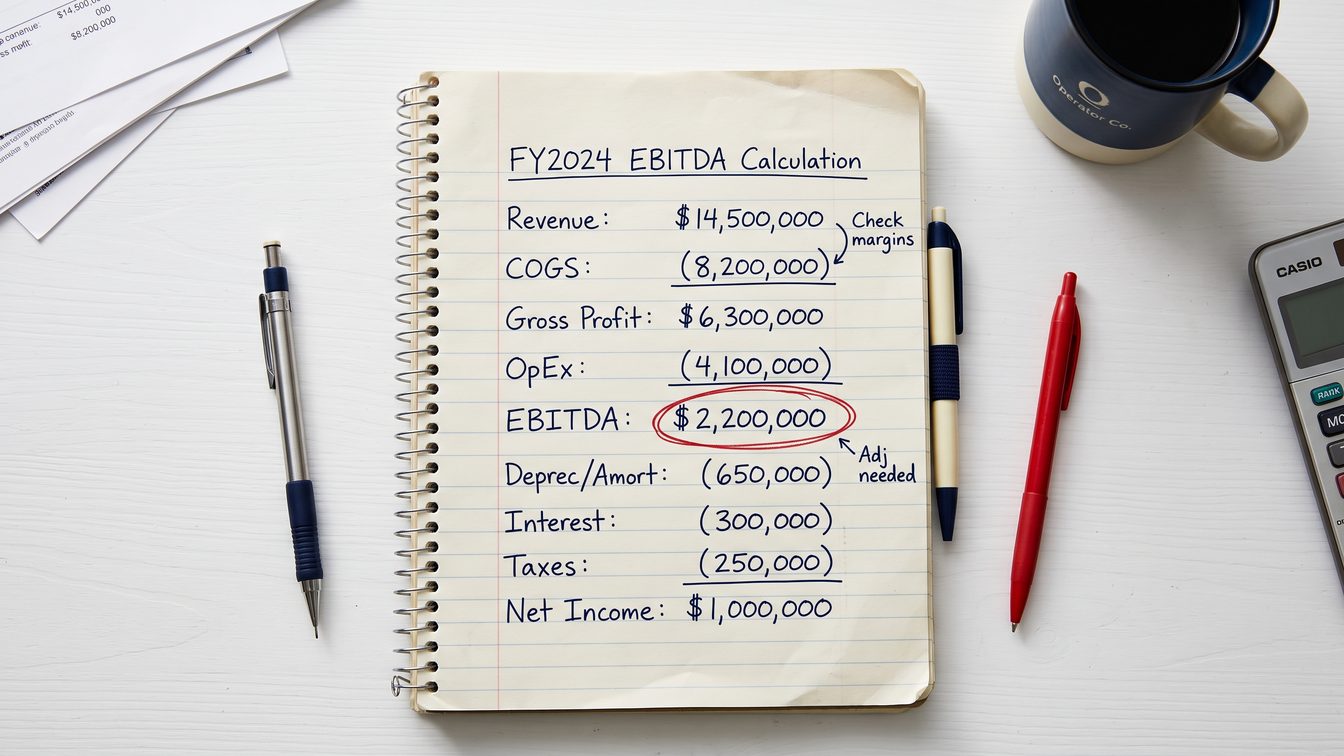
TL;DR: According to the 2024 Stanford GSB Search Fund Study, the median search fund acquisition had $2.2 million in EBITDA and sold for $14.4 million at a 7.0x multiple. That number is not an accident. It sits at the intersection of three constraints: enough cash flow to service acquisition debt, insufficient size to attract institutional competition, and enough management infrastructure that you're running a company, not a job.
The three-zone model
Every search fund acquisition sits in one of three zones. Understanding which zone you're in before you sign an IOI determines whether your next five years are an operator story or a cautionary tale.
Zone 1: Below $750K EBITDA. You're not buying a business. You're buying a job with debt. After annual debt service on a $1.5M loan (roughly $300K to $400K per year at current rates) and a minimal CEO salary of $120K, there is nothing left for reinvestment, unexpected expenses, or the thin management layer you'd need to actually run a company. Businesses at this size typically have no controller, no ops manager, no sales lead. They have the prior owner, who is leaving. When that owner walks out the door, you walk into their inbox.
Zone 2: $750K to $5M EBITDA. This is the search fund sweet spot. Businesses here have crossed the professionalization threshold. They have at least one layer of management between the owner and daily operations. Their revenue is diverse enough that losing one customer doesn't collapse cash flow. Their EBITDA is sufficient to service acquisition debt, pay a market-rate CEO salary, and fund growth reinvestment simultaneously. Stanford's 40 years of data confirms this is where outcomes cluster.
Zone 3: Above $5M EBITDA. You are now competing against institutional capital. Private equity firms, family offices, independent sponsors, and strategic acquirers all target this range aggressively. They have more capital, faster due diligence timelines, and the ability to pay higher multiples. That competition pushes entry prices to 8x or more, compressing returns. A search fund can win in this zone, but it requires institutional-grade deal sourcing, a deeper capital syndicate, and a compelling angle on why you can outbid PE on something other than price.
The math on deal size
A Yale School of Management research study on search fund entrepreneur economics quantified what most operators feel intuitively: every additional $500K of EBITDA at entry produces disproportionately larger outcomes at exit.
At a $2.0M EBITDA starting point, the study's base case projected an operator payout of approximately $2.61M. Increase the starting EBITDA to $2.5M, holding all other variables constant, and the operator's projected payout rises to $3.46M — a 32% increase for a 25% increase in business size. Push to $3.0M EBITDA and the payout reaches $4.31M, a 65% improvement over the $2.0M baseline.
The reverse is equally punishing. Drop to $1.5M EBITDA and the projected operator payout falls to $1.77M — a 32% contraction. At $1.0M EBITDA, it collapses to $0.96M. That's five years of operating a business, servicing acquisition debt, and managing investors for less than $1M in personal proceeds.
The mechanism is leverage, not magic. A larger EBITDA base means more dollars working for the operator's equity stake across the hold period. The operator's equity percentage is roughly the same whether the business has $1M or $3M in EBITDA. But 22% of $20M is very different from 22% of $6M.
What the Stanford data shows
The 2024 Stanford study analyzed 681 funds formed since 1984. The median acquired company posted these characteristics at close:
- EBITDA: $2.2 million
- EBITDA margin: 27%
- Pre-acquisition EBITDA growth: 25%
- Enterprise value: $14.4 million
- Purchase multiple: 7.0x EBITDA
Enterprise values have trended upward. A decade ago, the median search fund deal closed at $5M to $8M enterprise value. That range has expanded to $8M to $15M as the asset class has matured and more capital has entered. Acquisition multiples for search funds still run below institutional PE, which preserves the return profile. But the floor has moved up.
The implication for operators evaluating targets today: a business with $1.5M EBITDA trading at 5x is a $7.5M deal. A business with $2.5M EBITDA at 5.5x is a $13.75M deal. These are different transactions in terms of capital required, lender relationships, and investor syndicate size. Know which deal you're actually building toward before you spend six months in outreach.
The capital stack by deal size
Deal size determines your financing options. That matters more than most searchers realize before they're sitting across the table from a banker.
For deals up to roughly $5M in total purchase price, SBA 7(a) loans cover most of the debt layer. Above that threshold, conventional acquisition financing takes over: typically 2.5x to 3.5x EBITDA in senior debt, 10% to 20% in seller financing, and investor equity to fill the gap. At $2M EBITDA and a 4.5x multiple ($9M purchase price), a standard capital stack looks like:
- Senior debt: $5.4M (3x EBITDA, serviced by business cash flow)
- Seller note: $1.35M (15% of enterprise value, deferred)
- Investor equity: $2.25M (25% of enterprise value)
Annual debt service at that structure runs $750K to $900K. With $2M in EBITDA, that leaves $1.1M to $1.25M for CEO compensation, taxes, and capital investment. The math works. It doesn't require aggressive growth assumptions or heroic margin expansion. It works on the business as it currently operates.
At $1M EBITDA, the same structure produces annual debt service that absorbs nearly all free cash flow. One unexpected expense, one customer departure, one bad quarter, and you're in a cash conversation with your bank that you don't want to have in year two of ownership.
The competition dynamic
EBITDA is a beacon. As your target's EBITDA rises, so does the number of buyers. GF Data reported in 2024 that 75% of private equity deals in the $1M to $10M EBITDA range were platform add-ons, meaning PE firms were already competing at scale in this zone for bolt-on acquisitions.
The structural advantage search funds have is below $5M in EBITDA. Most PE platform strategies require companies above that threshold to function as a real platform. Below it, PE is shopping for add-ons, not platforms. That's a different buyer with different urgency and different flexibility on seller terms, transition periods, and deal structure.
Search funds can win deals below $5M EBITDA not just on price, but on fit. A veteran operator who grew up in a similar business, who speaks the same language as the retiring owner, who doesn't need a hundred-day integration playbook because they understand the operation, is a more attractive buyer than a PE-backed portfolio company running a tuck-in playbook.
What PGC looks for
At Patriot Growth Capital, we work with veteran operators pursuing lower-middle-market acquisitions. The $1.5M to $5M EBITDA range is our operating zone, and the Stanford data supports why. See our search fund economics primer for the full return structure.
The veteran operators who succeed in this range share one characteristic: they don't confuse EBITDA margin with EBITDA dollars. A $1.5M EBITDA business with 40% margins is not a better acquisition than a $2.5M EBITDA business with 28% margins, assuming comparable growth profiles and capital requirements. The dollars are what service debt, fund reinvestment, and drive the equity outcome. Margin matters at exit, when buyers evaluate sustainability. On the way in, the dollars are what you're underwriting.
Size is within the searcher's control in a way most other acquisition variables are not. You choose what you target. That choice, made before you source a single deal, sets the ceiling on your outcome before you've done a day of work.
Target bigger within your zone. It pays proportionately.
Patriot Growth Capital partners with veteran-led operators pursuing ETA and lower-middle-market acquisitions. ATLVets affiliated. 5% of revenue donated to the veteran community. Based in Atlanta, GA. Nothing in this article constitutes investment advice or a solicitation. All transactions involve risk.
Frequently Asked Questions
What EBITDA and purchase price did the median search fund acquisition reach?
The 2024 Stanford GSB Search Fund Study found the median acquired company had $2.2 million in EBITDA and sold for $14.4 million at a 7.0x multiple. The median EBITDA margin was 27% and pre-acquisition EBITDA growth was 25%. Those figures reflect 681 funds formed since 1984.
Why do acquisitions below $750K in EBITDA create serious financial risk for operators?
At that size, debt service on an acquisition loan and a minimal CEO salary of $120,000 absorb nearly all available cash flow. There is nothing left for reinvestment, unexpected expenses, or the management layer needed to run the company. When the prior owner leaves, the operator steps directly into the owner's daily responsibilities with no margin for error.
How does each additional $500K of EBITDA at entry affect the operator's projected payout?
A Yale School of Management study on search fund entrepreneur economics found that starting at $2.0 million in EBITDA, the base case operator payout was approximately $2.61 million. Increasing entry EBITDA to $2.5 million raised the projected payout to $3.46 million, a 32% increase for a 25% increase in business size. At $3.0 million EBITDA, the projected payout reached $4.31 million, a 65% improvement over the $2.0 million baseline.
What does a typical capital stack look like for a deal at a $2 million EBITDA target?
At $2 million in EBITDA and a 4.5x multiple, which produces a $9 million purchase price, a standard structure places $5.4 million in senior debt at 3x EBITDA, $1.35 million in a seller note representing 15% of enterprise value, and $2.25 million in investor equity at 25% of enterprise value. Annual debt service at that structure runs $750,000 to $900,000, leaving $1.1 million to $1.25 million for CEO compensation, taxes, and capital investment.