Most searchers spend months negotiating purchase price. They run financial models, benchmark EBITDA multiples, and argue over trailing vs. forward earnings. According to SearchFundMarket's 2025 capital stack analysis, the single most common reason deals fail in the final stretch is not price disagreement. It is structure. The seller wants all cash at close. The buyer needs to minimize equity. The bank has its own requirements. Someone who does not understand how these three interests fit together will not close the deal.
The capital stack is the blueprint. Here is how it works.
The Three Layers
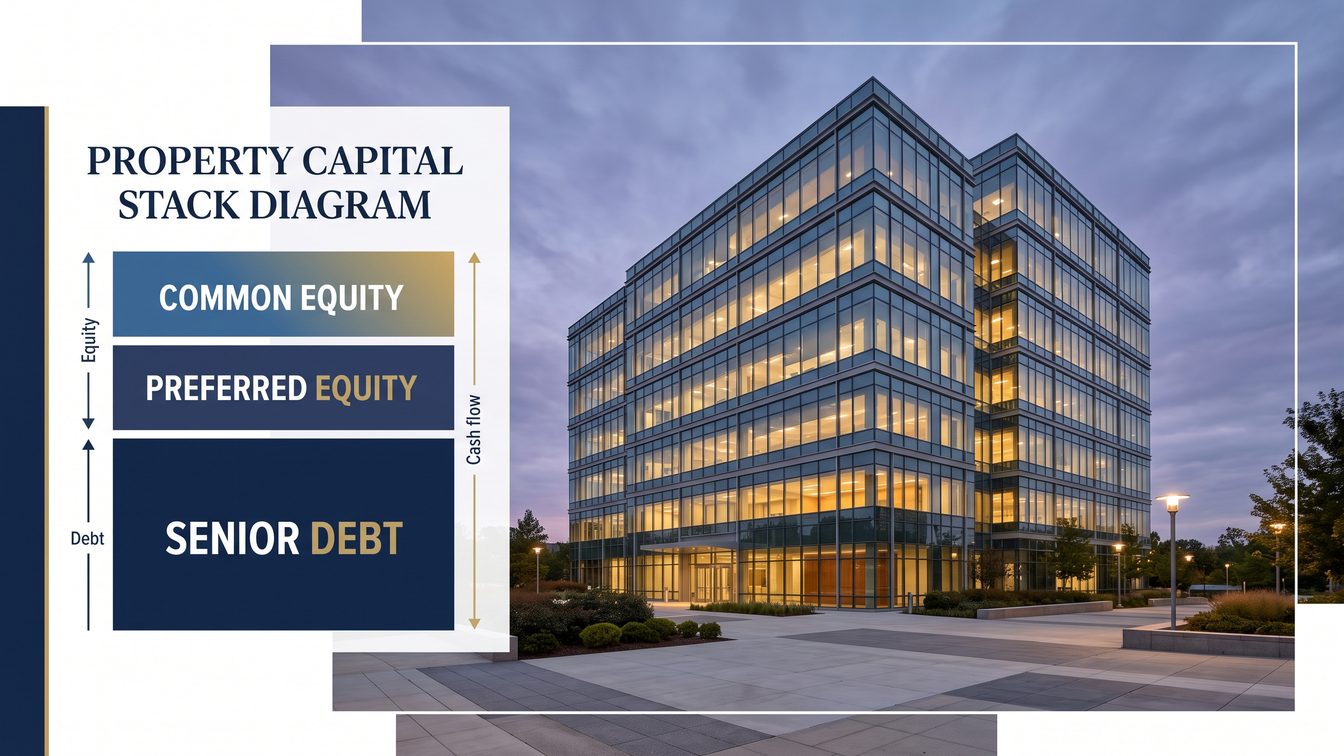
Every search fund acquisition is financed with at least two, usually three, layers of capital. Each layer has a different cost, a different risk profile, and a different claim on the business's cash flows.
Senior debt sits at the top. It has the first claim on cash flows and assets. The lender takes the least risk and accepts the lowest return. This is your bank loan or SBA 7(a) facility.
The seller note sits in the middle. The seller agrees to receive a portion of the purchase price over time instead of all cash at close. It is subordinated to the senior debt. The lender's claim comes first.
Equity sits at the bottom. It absorbs losses first and captures the most upside. This is where your LP investors or your own personal capital lives, depending on whether you are running a traditional or self-funded search.
Layer One: Senior Debt
In a traditional search fund deal, senior debt covers 50-65% of the purchase price. In a self-funded search using SBA 7(a) financing, that number climbs to 70-80%.
The SBA 7(a) program is the most important financing tool for US-based searchers. Key terms: loans up to $5M, 10-year repayment, interest at Prime plus 2.25-2.75% (currently variable, around 10-12% depending on when you're reading this), personal guarantee required for any owner above 20%, and an equity injection floor of 10%. The SBA loan's government guarantee is what lets lenders extend better terms than they would on a conventional small business loan.
Conventional bank debt, for deals above the $5M SBA ceiling, typically requires stronger borrower equity (30-40%) and shorter repayment terms. The SBA program is specifically designed to bridge that gap for first-time business owners, which is exactly the profile of most search fund operators.
The primary constraint on senior debt is not willingness to lend. It is debt service coverage. Most lenders require 1.25x DSCR: the business needs to generate $1.25 in cash flow for every $1 in annual debt payments. This is the ceiling on how much debt you can layer in. A business generating $2.2M EBITDA (the median for search fund acquisitions, per Stanford's 2024 data) can typically support $1.8M-$2.0M in annual debt service, which limits the total senior debt to roughly $12M-$14M at current rates.
Layer Two: The Seller Note
The seller note is 10-20% of the purchase price. The seller agrees to receive that portion over time, typically at 3-6% interest over a 3-7 year term. This rate is well below what subordinated debt would cost from a third-party lender. The seller accepts the lower rate because they are already motivated to close and because a seller note often enables a deal that would not otherwise happen.
If you are using SBA financing, the seller note has an additional requirement: full standby for 24 months. No principal payments, no interest payments, for the first two years. The SBA requires this because it wants the government-backed loan to be serviced first. Interest accrues during standby, which is why you negotiate the rate down to 5-6% rather than the 7-8% a motivated seller might initially ask for.
Sellers often resist standby notes. They want liquidity at close. The counter is simple: without the seller note, the deal structure cannot support the same valuation. The seller note is the mechanism that lets you pay full price. Resistance softens when that math is clear.
Seller notes also align interests. A seller carrying a note is more motivated to assist in the transition, answer calls from customers, and help you through year one. That alignment has real operational value beyond the financing mechanics.
Layer Three: Equity
This is where the two models diverge most sharply.
In a traditional search fund, equity comes from your LP investor pool. These are the 10-20 investors who funded your search period and who have the right of first refusal on acquisition equity. They are writing checks that represent 20-35% of the purchase price, and they expect 25-35% IRR on that capital. The median equity check across traditional search fund acquisitions is approximately $5.3M, representing roughly 40% of enterprise value, according to the Stanford GSB 2024 data.
In a self-funded search, equity is 10-15% of the purchase price, and most of it comes from the operator's own capital. A $2M acquisition requires roughly $200K-$350K in personal funds. You own 100% of the equity instead of the 20-30% a traditional search fund operator typically earns after the step-up vest. Lower equity at close, lower IRR for outside investors (because there are none), full upside for the operator if the business performs.
The right model depends on deal size. SBA self-funded works best for businesses with $500K-$1.5M EBITDA. Traditional search fund structure fits businesses with $1.5M-$5M EBITDA, where LP equity is required to close.
What the Math Looks Like at the Median Deal
Stanford's 2024 data puts the median search fund acquisition at $14.4M purchase price, $2.2M EBITDA, 7.0x multiple.
Here is what the capital stack looks like at that price point for each model:
| Layer | Traditional SF | SBA Self-Funded |
|---|---|---|
| Senior debt | $7.2M-$9.4M (50-65%) | $5.0M max (SBA cap) |
| Seller note | $1.4M-$2.9M (10-20%) | $1.4M-$2.2M (10-15%) |
| Equity | $2.9M-$5M (20-35%) | $1.4M-$2.2M (10-15%) |
Note that a $14.4M deal at SBA terms would require a second SBA loan, a conventional bank loan for the remainder above the $5M cap, or simply a smaller target. The SBA program works well for deals under $6M-$7M in enterprise value. Above that, you need conventional bank financing, which typically means more equity and a more conservative structure.
Where Operators Make Structure Mistakes
Three patterns repeat across failed search fund closings.
First: offering too little seller financing. Sellers want cash at close. Buyers want to preserve equity. The seller note is the bridge. Operators who go in with less than 10% seller financing either end up overpaying (more investor equity, which dilutes the operator's ultimate stake) or losing the deal to a buyer who structures it better.
Second: not modeling debt service coverage before LOI. You run the EBITDA model, apply the multiple, and call it good. But if the business cannot actually service the debt load at 1.25x DSCR with the structure you have proposed, the bank will not fund it. Run the debt service math before you sign the LOI. Know the annual payment on your senior debt. Know whether the business cash flow supports it.
Third: choosing the wrong financing source for the deal size. SBA works. It works very well for deals under $5M in enterprise value. It does not work for a $12M acquisition that requires $8M-$9M in senior debt. Operators who try to force SBA onto a deal that needs conventional financing waste months on a path that will not close.
How PGC Thinks About Structure
At Patriot Growth Capital, deal structure is part of our acquisition underwriting, not an afterthought. We evaluate operator candidates on their ability to read a capital stack the same way we evaluate their operational judgment. Learn more about how we approach the full search fund acquisition financing process.
The businesses we acquire are built on repeatable cash flow. That cash flow has to service the debt, fund operations, and leave room for the operator to invest in growth. A structure that maximizes purchase price at the expense of coverage ratio is not conservative investing. It is a bet on things going right in year one.
Things rarely go exactly right in year one.
The right structure leaves margin. It keeps debt service manageable even if revenue comes in 10% below plan. It gives the seller a note structure they understand and will honor. It gives LP investors an equity stake that returns 25-35% IRR without requiring heroic performance from the operator on day one.
Structure is not about being clever. It is about designing a deal that closes, stays closed, and gives the operator room to run the business instead of managing the capitalization table.
Frequently Asked Questions
What are the three layers of capital in a search fund acquisition?
Every search fund acquisition is financed with senior debt, a seller note, and equity. Senior debt sits at the top with the first claim on cash flows and assets. The seller note is subordinated to the senior debt. Equity sits at the bottom, absorbs losses first, and captures the most upside.
What debt service coverage ratio do most lenders require on a search fund deal?
Most lenders require 1.25x DSCR, meaning the business must generate $1.25 in cash flow for every $1 in annual debt payments. This coverage requirement is the ceiling on how much debt can be added to the capital stack, not the lender's willingness to lend.
Why do sellers resist standby seller notes, and how should buyers respond?
Sellers resist standby notes because they want liquidity at close. The effective counter is that without the seller note, the deal structure cannot support the same valuation. Resistance typically softens when that math is made clear, and a seller note also aligns the seller's interests through the transition.
What is the difference between how traditional and self-funded search funds handle equity?
In a traditional search fund, equity of 20 to 35 percent of the purchase price comes from an LP investor pool of 10 to 20 investors who expect 25 to 35 percent IRR. In a self-funded search using SBA financing, equity is 10 to 15 percent and comes mostly from the operator's own capital, but the operator owns 100 percent of the equity rather than the 20 to 30 percent typical in a traditional structure.